



If you haul horses long enough, you learn one thing fast: your trailer and your tow hitch matters more than most people realize. Hauling livestock and horses is completely different from pulling a standard flatbed or enclosed trailer because you are dealing with living animals whose center of gravity is much higher off the ground. A rough ride doesn’t just beat up your truck and trailer; it affects your horses, too. Excessive chucking, jerking, bouncing, and road shock can create trailer sway, increase driver fatigue, and make every mile harder on your animals.
Type of Horse Trailers
To effectively compare bumper pull and gooseneck horse trailers, it is best to evaluate several key metrics. These include hitch placement, type of hitch, tow vehicle compatibility, maneuverability, weight, overall costs, and horse capacity, as well as living quarters, safety, legal regulations, and long-term durability. Learn more about the types of horse trailers.
Best Hitches for Bumper Pull Horse Trailers
The best hitch for a bumper pull horse trailer depends on the trailer’s loaded weight, tongue weight, tow vehicle and the amount of cushioning or sway control needed. Because horses are live cargo, reducing road shock, bouncing and forward and back chucking can improve comfort for both the horses and driver.
Air Ride Receiver Hitch: An air ride receiver hitch is often the overall best choice for improving ride quality when towing a bumper pull horse trailer. Instead of using a rigid connection, an air spring and built-in movement help absorb road shock, vibration, bouncing and forward-and-back chucking. Which ultimately makes it easier on you, your horses and equipment. Benefits includes smoother ride, less road shock, improved driver and hose comfort, less stress on truck, trailer and cargo. Plus it is fully adjustable for difference trailer loads.
Weight Distribution Hitch: Often called a WD hitch uses load spring bars to transfer some tongue weight from the truck’s rear axle toward the front axle and trailer axles. It can help restore vehicle balance when a heavy bumper-pull trailer causes excessive rear-end squat. Benefits include better steering and braking, reduced rear truck squat, more level truck and trailer, improved stability with heavier loads and front axle weight distribution. However it is a rigid or solid connection between the truck and horse trailer. So if the truck feels a bump so will the trailer. Good for weight distribution but not so go for ride comfort. One way to improve this is to get an air ride weight distribution hitch, then you also get the benefits of air hitch towing..
Sway Control Hitch: A sway control hitch system or sway control towing kit helps resist unwanted side-to-side trailer movement caused by crosswinds, passing trucks, sudden steering corrections or improper loading. Some weight-distribution systems include integrated sway control. Friction-style sway-control devices may also be added to compatible trailer and hitch setups. Sway control can improve stability, but it cannot correct an improperly loaded trailer, insufficient tongue weight or an undersized tow vehicle. Upgrading to an air ride receiver sway control hitch kit will add the benefits of an air hitch to the sway control benefits. Adding sway control air weight distribution hitch give you the additional benefits of a wd hitch and an air ride hitch.
Cushioned Hitch: A cushioned hitch for a receiver hitch that is used for bumper pull trailers uses rubber, polyurethane or another compressible material to soften some of the shock transferred through the connection. This is a better option than a rigid or solid traditional hitch and ball mount. Benefits include some reduction in road shock, minimal adjustment or maintenance. A cushion hitch can improve ride quality, although it generally provides less movement and no shock absorbing adjustability compared to a true air ride hitch. There are also sway control cushion hitch towing kits that adds the benefits of a sway control hitch. Plus there are cushion style wd hitches that add the benefit of a weight distribution hitch.
Traditional Solid / Ridge Hitch Ball Mount: A solid ball mount hitch, like the XR series hitches, which are the simplest and most affordable option. It may work well for lighter trailers and shorter trips when the truck and trailer are properly matched. However, its rigid steel connection transfers more road shock, vibration and chucking directly between the tow vehicle and trailer. This can create a rougher ride for the driver and horses, particularly on uneven roads or during long-distance towing. This is not a good option for reducing stress for your horses, however it will get them from point a to point b. You can also get a traditional sway control hitch kit that add the benefits of a sway control hitch, which helps with trailer sway but do not help with absorbing road shock, bumps or trailer bouncing.
Quick Reference Guide: Best Hitches for Bumper Pull Horse Trailers
| Hitch Type | Best For | Ride Comfort | Weight Distribution | Sway Control | Key Consideration |
|---|---|---|---|---|---|
Air-Ride Receiver Hitch | Reducing road shock, bouncing and forward-and-back chucking | Excellent | No | Available with compatible kits | Adjustable air pressure helps accommodate different trailer loads. |
Air-Ride Weight-Distribution Hitch | Combining improved ride quality with weight distribution | Excellent | Yes | Available | Helps reduce rear truck squat while cushioning the truck-and-trailer connection. |
Air-Ride Sway-Control Hitch Kit | Combining air-ride comfort with trailer-sway control | Excellent | No | Yes | Helps reduce road shock, chucking and side-to-side trailer movement. |
Air-Ride WD Hitch With Sway Control | Heavier horse trailers needing cushioning, weight distribution and sway control | Excellent | Yes | Yes | The most complete option when all three functions are needed. |
| Traditional Weight-Distribution Hitch | Reducing truck squat and restoring front-axle load | Fair | Yes | Sometimes | Improves weight distribution but usually maintains a rigid connection. |
Traditional Sway-Control Hitch Kit | Reducing side-to-side trailer movement | Fair | No | Yes | Helps manage sway but does not cushion road shock or trailer bounce. |
Cushion Hitch | Basic cushioning with minimal adjustment or maintenance | Good | No | Available with compatible kits | Provides some shock reduction but is not adjustable like an air hitch. |
Traditional Solid Ball Mount | Lighter trailers, shorter trips and budget-conscious towing | Basic | No | Available with compatible kits | Simple and affordable, but transfers more road shock and chucking. |
Which Bumper Pull Horse Trailer Hitch Is Best?
- Best overall for ride comfort: Air-ride receiver hitch
- Best for reducing rear truck squat: Weight-distribution hitch
- Best for controlling side-to-side movement: Sway-control hitch
- Best combination of comfort and weight distribution: Air-ride weight-distribution hitch
- Best complete towing system: Air-ride weight-distribution hitch with sway control
- Best basic cushioned option: Cushioned receiver hitch
- Best affordable option: Traditional solid ball mount
Weight distribution, sway control and cushioning perform different jobs. Weight distribution helps balance tongue weight, sway control helps resist side-to-side movement, and air-ride cushioning helps absorb road shock, bouncing and forward-and-back chucking. The best system depends on which problems your towing setup needs to address
Best Hitches for Gooseneck Horse Trailers
The best towing hitch for a gooseneck horse trailer is a air ride gooseneck hitch and coupler. Picking the best hitch for a gooseneck horse trailer depends on the trailer’s loaded weight, vertical load, coupler and stem size, tow vehicle and desired ride quality. Although a gooseneck connection generally provides greater stability and less sway than a bumper pull trailer connection, a rigid gooseneck coupler can still transfer substantial road shock, bouncing and forward and back chucking between the truck and trailer. Because horses are live cargo, a gooseneck hitch that cushions this movement can provide a smoother ride for the horses and driver while reducing stress on the truck, trailer and equipment.
Gooseneck Air Hitch: An air ride gooseneck hitch & coupler is the overall best for towing horses with a gooseneck horse trailer. A gooseneck air hitch and coupler is by far best overall choice for improving ride quality when towing a gooseneck horse trailer. It replaces the trailer’s rigid inner coupler tube and uses an air spring with built-in movement to isolate the truck and trailer from one another. Since A surge-style air-ride gooseneck coupler uses an air spring and controlled pivoting movement to absorb both vertical impact and forward and back movement. This creates a way smoother ride and is less stressful on the horses than a cushion or tradition gooseneck hitch and coupler. The benefits of a gooseneck air hitch include being excellent a reducing trailer chucking and bucking, better at reducing road shock. They definitely create a smoother ride for horses and the driver along with less stress and damage on truck, gooseneck horse trailer and cargo. They are adjustable for trailer weight and ride comfort for short and long distances. An air ride gooseneck hitch design is especially beneficial for gooseneck horse trailers because it helps isolate the horses from the harsh pushing, pulling and jerking created by rough roads, acceleration and braking. It is a great option for gooseneck horse trailer owners looking to reduce road shock and improve ride quality while retaining a strong, compact gooseneck connection. If towing with a short bed pickup or if extra cab clearance is needed, an air ride gooseneck hitch with offset coupler may be the best option.
Gooseneck Cushion Hitch: A cushioning gooseneck hitch & coupler uses rubber, polyurethane, torsion material or another compressible component to soften some of the shock transferred through the connection. It provides a less rigid connection than a traditional solid gooseneck coupler and generally requires little adjustment or maintenance. However, it normally offers less movement and no load-specific cushioning adjustment compared with a gooseneck air hitch and coupler. Gooseneck cushion hitch benefits include some reduction in road shock, simple construction, minimal adjustment and maintenance and is less rigid than a traditional solid gooseneck coupler. It can’t be adjusted for weight so often can be a little too stiff or a little to soft. If your tow weight changes a bunch, up or down, so does the stiffness or softness.
Cushioned Gooseneck Ball: An in-bed cushioning gooseneck ball is sightly better than a solid gooseneck hitch and coupler. It installs in the truck bed and uses rubber, polyurethane or controlled pivoting movement to reduce some of the shock transferred through the gooseneck connection. Unlike an air ride gooseneck hitch and coupler installed on the trailer, the cushioning is built into or beneath the truck side hitch ball. Benefits include some reduction in forward and back chucking, slightly less road shock transferred into the truck and gooseneck horse trailer and a slightly improved ride quality compared with a rigid gooseneck ball. Generally, no modification to the trailer’s gooseneck coupler. They are often compatible with factory puck and under-bed hitch systems. A cushioned gooseneck ball can slightly improve comfort, but it normally has limited movement and is not adjustable for different trailer loads. It may also provide less vertical shock isolation and chucking reduction than a full air ride or cushion gooseneck hitch and coupler.
Solid / Traditional Gooseneck Coupler: A traditional solid gooseneck coupler is the simplest and most common option. It consists of a rigid inner tube and coupler that connect the trailer directly to the gooseneck ball in the truck bed. Solid gooseneck couplers are dependable and affordable, but their rigid construction transfers more road shock, vibration, bouncing and forward-and-back chucking between the truck and gooseneck horse trailer. A solid gooseneck coupler may be adequate for lighter trailers and shorter trips. However, it is generally not the best option when ride comfort for the horses or driver is the primary concern. This gets the job done but will be more stressful on your horses, truck, trailer & equipment.
Quick Reference Guide: Best Hitches for Gooseneck Horse Trailers
| Hitch Type | Best For | Ride Comfort | Chucking Reduction | Adjustable Cushioning | Key Consideration |
|---|---|---|---|---|---|
| Gooseneck Air Hitch and Coupler | Smoother, more adjustable towing for horses and the driver | Excellent | Excellent | Yes | Uses an adjustable air spring and controlled movement to reduce road shock, trailer bucking and forward-and-back chucking. |
| Gooseneck Cushion Hitch and Coupler | Basic cushioning with minimal adjustment or maintenance | Good | Good | No | Uses rubber, polyurethane or torsion material, but its cushioning cannot be adjusted for changing trailer loads. |
| Cushioned Gooseneck Ball | Adding limited cushioning without replacing the trailer’s coupler | Fair | Fair | Usually No | Installs on the truck side and provides less movement and shock isolation than a complete air or cushioned coupler. |
| Solid Gooseneck Coupler | Budget-conscious towing, lighter trailers and shorter trips | Basic | Minimal | No | Simple and dependable, but its rigid connection transfers more shock, vibration and chucking. |
Which Gooseneck Horse Trailer Hitch Is Best?
- Best overall for horses and ride comfort: Gooseneck air hitch and coupler
- Best for reducing forward-and-back chucking and trailer bucking: Gooseneck air hitch and coupler
- Best for changing trailer weights: Adjustable gooseneck air hitch
- Best basic cushioned option: Gooseneck cushion hitch and coupler
- Best without replacing the gooseneck trailer’s coupler: Cushioned gooseneck ball
- Best affordable option: Traditional solid gooseneck coupler
Air, cushion and solid gooseneck hitches handle towing forces differently. An air ride gooseneck hitch and coupler uses adjustable air-spring cushioning and controlled movement. A cushion hitch relies on fixed rubber, polyurethane or torsion material. A solid gooseneck coupler provides little to no shock isolation. For gooseneck horse trailers, better isolation can mean less road shock, bouncing and chucking transferred to the horses, driver, truck and trailer.
Benefits of Smoother Towing for Horses
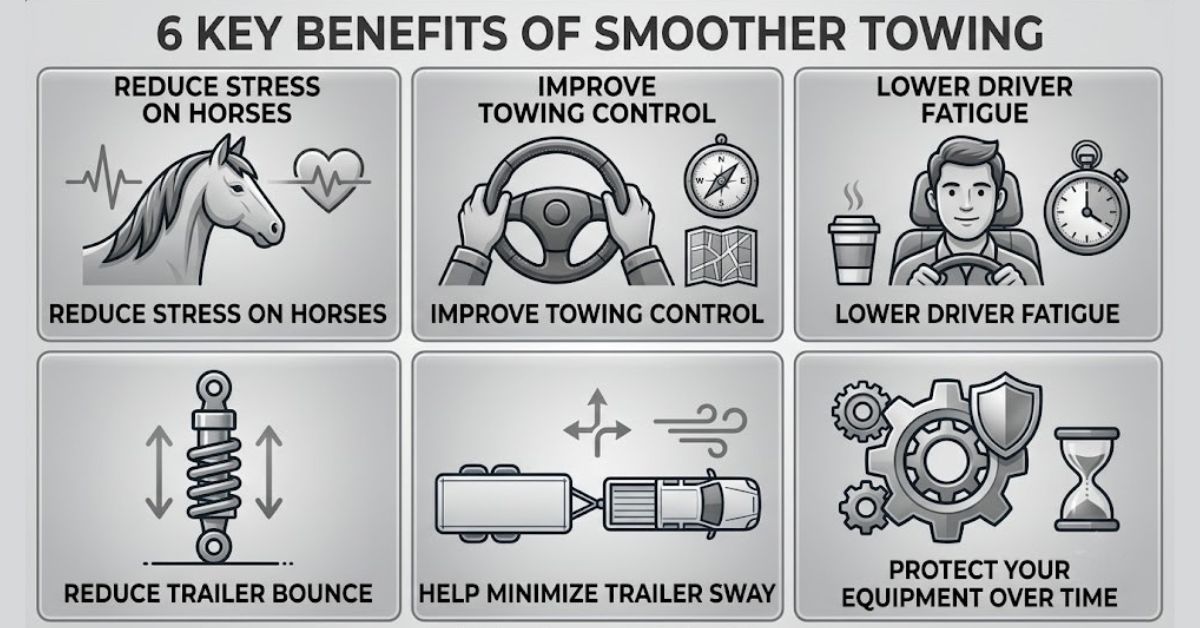
Why Horse Trailers Need a Better Hitch System
When hauling a heavy, live load with a high center of gravity, a standard rigid ball mount simply isn’t enough. Shocker Hitch air ride towing systems are specifically engineered to eliminate the rough, rigid connection that causes stress to your animals and wear on your equipment.
By utilizing built-in air ride technology, a Shocker Hitch acts as a heavy-duty shock absorber between your tow vehicle and horse trailer. This intelligent design captures and dampens road shock before it ever reaches the trailer frame.
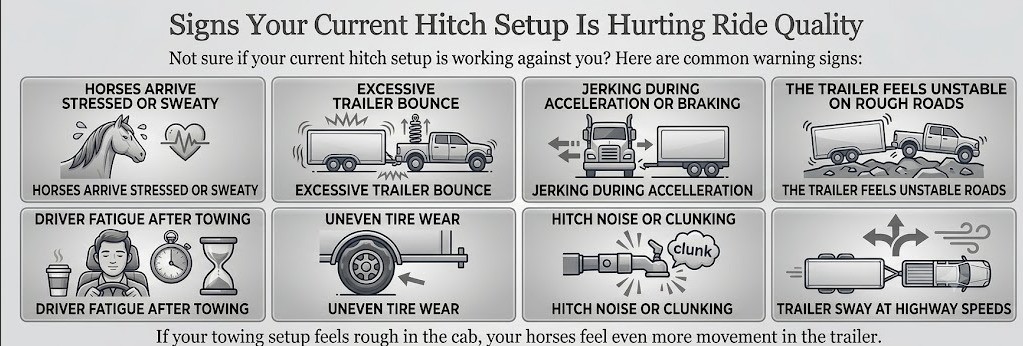
Signs Your Current Hitch Setup Is Hurting Your Horse Ride Quality
Not sure if your current hitch setup is working against you? Here are common warning signs:
- Horses arrive stressed or sweaty
- Excessive trailer bounce
- Jerking and trailer chucking during acceleration or braking
- The trailer feels unstable on rough roads
- Driver fatigue after towing
- Uneven tire wear
- Hitch noise or clunking
- Trailer sway at highway speeds
Why Gooseneck Air Ride Hitches Are Becoming More Popular for Horse Hauling
More horse owners are switching to air ride gooseneck hitch and coupler systems because they help solve some of the biggest towing problems: The reducing bucking and chucking. Reduce stress on passengers and animals. Improve ride comfort and are adjustable for changing tow weights.
Traditional rigid hitches create a direct steel-on-steel connection. Every road imperfection transfers force instantly between the trailer and truck. Air ride technology helps absorb and dampen those forces before they reach the trailer, protecting your truck and trailer frame and creating a safer, smoother ride for you, your passengers, and your cargo.
Drivers hauling expensive horses, show horses, race horses, and livestock increasingly look for towing setups that prioritize ride quality and stability. A gooseneck air ride hitch and coupler reduces wear and tear on the pickup truck, driveline, trailer and frame. The shock absorbing and dampening design of an gooseneck air hitch for a horse trailer or an air receiver hitch for a bumper pull horse trailer creates less stress on tow vehicle, horses, passengers and the trailer. Less stress means less wear and tear on both the tow vehicle and the horse trailer frame and welds. An air ride hitch will greatly reduce the chances of frame cracking and breaking. An air ride hitch design filters the natural tugs between the horse trailer and pickup giving you more control and comfort when towing a trailer. By giving you improved control of your tow vehicle and trailer, it is safer. The air ride hitch system allows for better control of your pickup and the trailer it is towing.
Level Towing Matters for Horse Trailers
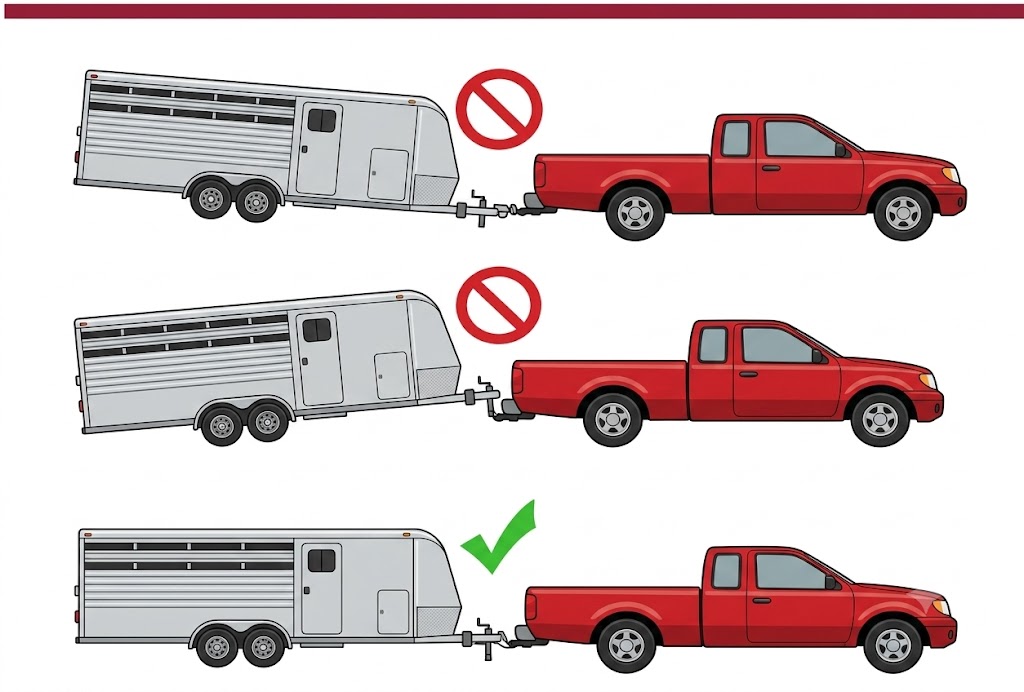
One of the most overlooked parts of horse trailer towing is keeping the trailer level.
An unlevel trailer can cause:
- Poor braking performance
- Increased sway
- Uneven axle loading
- Rougher ride quality
- Premature tire wear
A properly adjusted hitch helps maintain a safer towing stance and better weight distribution.
If your trailer nose is too high or too low, it can negatively affect both towing performance and horse comfort.
Best Trucks for Horse Trailer Towing
The gooseneck hitch and coupler is only one part of the towing equation. Your pickup truck setup also matters. Popular trucks used for hauling horse trailers include:
- Ford Super Duty
- Ram 2500
- Ram 3500
- Chevrolet Silverado 2500 and 3500 HD
- GMC Sierra 2500 and 3500 HD
No matter what truck you drive, reducing trailer shock and improving ride quality should always be a priority when hauling horses.
FAQ
- Do I Need an Offset Gooseneck Coupler?
- Air Ride vs Cushion vs Solid Hitches
- Advantages of Air Hitches
- How to Back Up a Gooseneck Trailer?
- Do I Have a Gooseneck or 5th Wheel?
- Understanding Towing Capacity
- Shocker Gooseneck Hitch Uses
- Best Types of Gooseneck Balls
- Why Grease Your Hitch Ball?
- How To Level Trailer
- How To Fix Truck Squatting
- Type of Round Gooseneck Stems
- Air Ride Gooseneck Couplers by Trailer Brand