



What does GTW, TW, CW, GVWR, GCWR & Hitch Weight Rating Capacity really mean? Understanding all these abbreviations can be difficult. Here is a comprehensive guide to understanding towing capacities. Some is related to the tow vehicle, some to the hitch, some to the trailer, and some everything.
- GTW is Gross Trailer Weight. This is the total, real-world weight of your full loaded trailer, including cargo, gear and equipment loaded in or on it.
- TW is Tongue Weight. The maximum downloaded force the trailer’s coupler exerts onto the hitch ball. For conventional bumper pull (tag trailer) towing, proper tongue weight should be about 10% of the total Gross Trailer Weight (GTW). For gooseneck and 5th wheel towing, proper tongue weight should be 15 to 25%. 20% is generally considered ideal.
- CW is Curb Weight. This is your vehicles weight empty. It includes standard equipment and operating fluids, but not passengers or cargo.
- GVWR is Gross Vehicle Weight Rating. This absolute maximum safe loaded weight you of your vehicle, determined by the manufacture. It includes the Curb Weight (CW) plus all the passengers.
- GCWR is Gross Combined Weight Rating. For towing, this is the most important as it is the absolute maximum allowable weight of your loaded truck and your loaded trailer combined.
- Hitch Weight Rating: This is the hitch weight rating capacity and it includes both the Gross Trailer Weight (GTW) and the Tongue Weight (TW), which define a hitch’s overall classification.
- Dry Weight: Weight of the vehicle without fuel, fluids, passengers, option equipment or cargo.
- Gross Axle Weight Rating: Maximum weight that can be placed on an individual axle, including the weight of the vehicle itself, passengers, cargo and any trailer tongue weight (TW).
- Payload: The total weight the vehicle can safely carry, including cargo, passengers, and any additional equipment, excluding the trucks own weight.
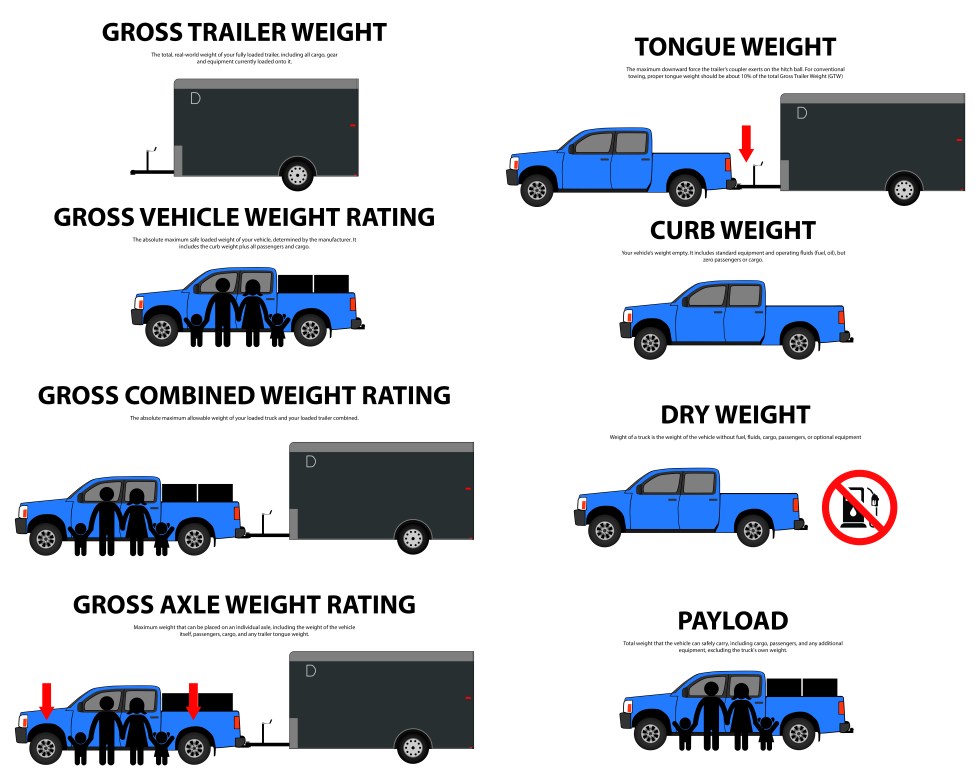
Key Towing Terms You Need to Know
- GTW (Gross Trailer Weight): The total, real-world weight of your fully loaded trailer, including all cargo, gear, and equipment currently loaded onto it.
- TW (Tongue Weight): The maximum downward force the trailer’s coupler exerts on the hitch ball. For conventional towing, the proper tongue weight should be a minimum 10% of the total Gross Trailer Weight (GTW).
- CW (Curb Weight): Your vehicle’s weight empty. It includes standard equipment and operating fluids (fuel, oil), but zero passengers or cargo.
- GVWR (Gross Vehicle Weight Rating): The absolute maximum safe loaded weight of your vehicle, determined by the manufacturer. It includes the curb weight plus all passengers, cargo, and trailer tongue weight. (Usually found on the driver’s side door jamb placard).
- GCWR (Gross Combined Weight Rating): The absolute maximum allowable weight of your loaded truck and your loaded trailer combined.
Not sure what your truck can handle?
Whether you are pulling a camper or a heavy equipment trailer, you need to know exactly what your tow vehicle and hitch are rated for. Exceeding your truck’s limits causes excessive wear on your engine, transmission, brakes, and suspension, and it creates a serious safety hazard on the road.
If your tow vehicle is attached to a trailer and you are unsure if you are within safe limits, you need to understand the fundamental differences between your truck’s towing capacity, your trailer’s actual weight, and your hitch’s weight rating.
Gross Vehicle Weight Rating (GVWR) vs. Gross Trailer Weight (GTW)
It is a common mistake to use “Towing Capacity” and “Gross Trailer Weight” interchangeably, but they are two entirely different measurements:
- Gross Vehicle Weight Rating (GVWR): Sometimes called Vehicle Towing Capacity. This is the maximum weight your truck can pull safely behind it. It is determined strictly by the vehicle manufacturer based on the engine, frame, and braking system.
- Gross Trailer Weight (GTW): This is the actual, real-world total weight of your fully loaded trailer and all of its cargo.
While your owner’s manual can help you find your truck’s vehicle towing capacity based on the Year, Make, Model, and Receiver Size, you must determine the actual Gross Trailer Weight (GTW) of what you are towing to ensure it falls under the truck’s limit.
Hitch Weight Rating Capacity: Hitches Don’t Tow, They Hold
Your truck has a towing capacity, but your hitch has a Hitch Weight Rating Capacity. Together, Gross Trailer Weight (GTW) and Tongue Weight (TW) define a hitch’s overall classification.
- Hitch Classification: Hitches are grouped into classes (Class I through V) based on the maximum weight they can safely handle. For example, a hitch designed to handle heavy-duty commercial use and large RVs is a Class V (Class 5) hitch.
- Hitch Weight Rating Capacity: This is the combination of the GTW and TW ratings for the hitch itself. For instance, a Shocker Air Ride Receiver Hitch rated for 20,000 lbs GTW and 2,000 lbs TW identifies as a Class V hitch.
| Hitch Class | Common Applications | Receiver Size | Gross Trailer Weight (GTW) Capacity (lbs.) | Tongue Weight (TW) Capacity (lbs.) |
| Class 1 | Car & Crossovers | 1.25 Inch | Up to 2,000 | Up to 200 |
| Class 2 | Crossovers & Minivans | 1.25 Inch | Up to 3,500 | Up to 350 |
| Class 3 | Crossovers, Vans, SUVs & Mid-Size Trucks | 2 Inch | Up to 8,000 | Up to 800 |
| Class 4 | Half Ton Trucks & SUVs | 2 Inch | Up to 10,000 | Up to 1,000 |
| Class 5 | HD Trucks | 2, 2.5, or 3″ Inch | Up to 20,000 | Up to 2,000 |
Note: Upgrading to a Class V hitch does not increase your truck’s Vehicle Towing Capacity. Your towing setup is only as strong as its lowest-rated component.
How to Calculate Your Max Vehicle Towing Capacity:
To find your exact towing capacity, you need to know your truck’s Gross Combined Weight Rating (GCWR) and subtract the actual loaded weight of the truck (Curb weight + passengers + cargo).
Gross Combined Weight Rating (GCWR) – Loaded Weight of Truck = Max Vehicle Towing Capacity
Once you have this number, you must ensure your trailer’s Gross Trailer Weight (GTW) does not exceed it. Always remember that adding more weight to the cab or bed of your truck directly reduces the amount of weight you can pull behind it.
Upgrade Your Towing Experience
If you have done the math and are within your vehicle’s towing limits but still experience a rough, rigid ride or trailer sway, upgrading your hitch setup with an air hitch can make a massive difference.
NOTE: When upgrading your towing setup, for bumper bull towing, an Air Ride Receiver Hitch should be your first option and overall best choice. It is incredibly versatile, instantly smooths out your ride, and protects both your truck and trailer from the damaging road shock of towing. However, if your truck is visibly sagging or squatting under the tongue weight or experiencing severe sway, you may need additional support to level your load. In that case, check out our guide on How Do I Know If I Need a Weight-Distribution Hitch or consider an Air Suspension Kit. For Gooseneck towing, a Gooseneck Air Hitch will greatly improve towing. For 5th Wheel towing, a Air Ride 5th Wheel Hitch which include 5th wheel to gooseneck conversion and options with kingpin. Either will greatly improve towing for a 5th wheel camper. Combining a leveled load with our air hitches delivers the ultimate smooth towing experience.
FAQ
- Types of Trailers
- How Do I Measure My Receiver Hitch Size?
- How to Level Your Trailer for Better Towing
- Do I Need Sway Control?
- How Much Drop Do I Need?
- Shocker Hitch Uses
- Advantages of an Air Tow Hitch
- Why a Level Truck and Trailer is Important
- Why Grease Hitch Ball?
- What If My Truck Squats with Trailer
- Do I Need An Offset Gooseneck Coupler?
- Do I Have a 5th Wheel or Gooseneck?