



Find your trailer connection
Bumper pull, gooseneck or fifth wheel? Start with where your trailer connects to the tow vehicle—and whether it uses a ball, pintle ring or kingpin.
This guide covers three common trailer connections and the measurements that help you choose a compatible hitch. A utility, horse, cargo or camper trailer can use different connections, so identify the hardware before ordering.
Identify your trailer at a glance
Bumper pull
The trailer connects behind the tow vehicle, commonly to a ball mount in a receiver hitch. Also called a tag or tag-along trailer.
Start with: receiver size, coupler or ring size, and drop or rise.
Gooseneck
The trailer neck extends over the truck bed, with a coupler that connects to a bed-mounted hitch ball.
Start with: stem shape and dimensions, pin-hole orientation and ball size.
Fifth wheel
A kingpin beneath the trailer’s pin box connects to a fifth-wheel hitch in the truck bed.
Start with: pin-box manufacturer/model, mounting pattern and hitch compatibility.
Connection behind the vehicle
Bumper-pull trailers: receiver hitch fit
Many utility, cargo, boat, horse and travel trailers use this connection. “Bumper pull” describes the trailer style; it does not mean any vehicle bumper is a suitable towing point. Use the rated towing equipment specified for your vehicle.
Shocker options include air receiver hitches, Impact™ cushion hitches, traditional channel-style hitches and compatible weight-distribution solutions.
Check these before ordering
- Receiver opening: measure the inside of the square receiver tube.
- Connection: match the hitch ball to the coupler marking, or choose a compatible pintle hook for a lunette ring.
- Height: measure the drop or rise needed for your loaded trailer.
- Ratings: confirm loaded trailer and tongue weights against the vehicle and every hitch component.

Do you need weight distribution?
Follow your vehicle, receiver and trailer instructions for when weight distribution is required and which systems are compatible. Squat alone is not a complete fitment test. Suspension air springs do not increase the vehicle’s weight ratings, and load-support equipment does not make an overloaded combination acceptable.
Read the weight-distribution guide and towing-capacity guide.
Shocker hitch options for bumper-pull trailers
- Air Ride Receiver Hitches — air-cushioned receiver options; select the receiver size, attachment and drop or rise for your setup.
- Impact™ Cushion Receiver Hitches — cushioned receiver-hitch options for compatible ball or pintle connections.
- Traditional Channel-Style Receiver Hitches — adjustable channel-style options, including XR models, for the required height and connection.
- Air Equalizer for Weight-Distribution Hitches — an air-ride option for a compatible weight-distribution setup.
- Air Ride Weight-Distribution Hitches — weight-distribution options with air ride; confirm the complete system’s vehicle, trailer and receiver compatibility.
Bumper-pull trailers with a bolt-on tongue coupler
A tongue mount is a mounting arrangement on a bumper-pull trailer, not a separate trailer connection category. Some trailer A-frames have a vertical channel or a four-bolt flat plate holding the coupler or pintle ring.
A compatible air-ride tongue mount installs at this trailer-side location. Confirm the mounting style, dimensions, bolt pattern, coupler or ring compatibility and required ratings before choosing a kit.
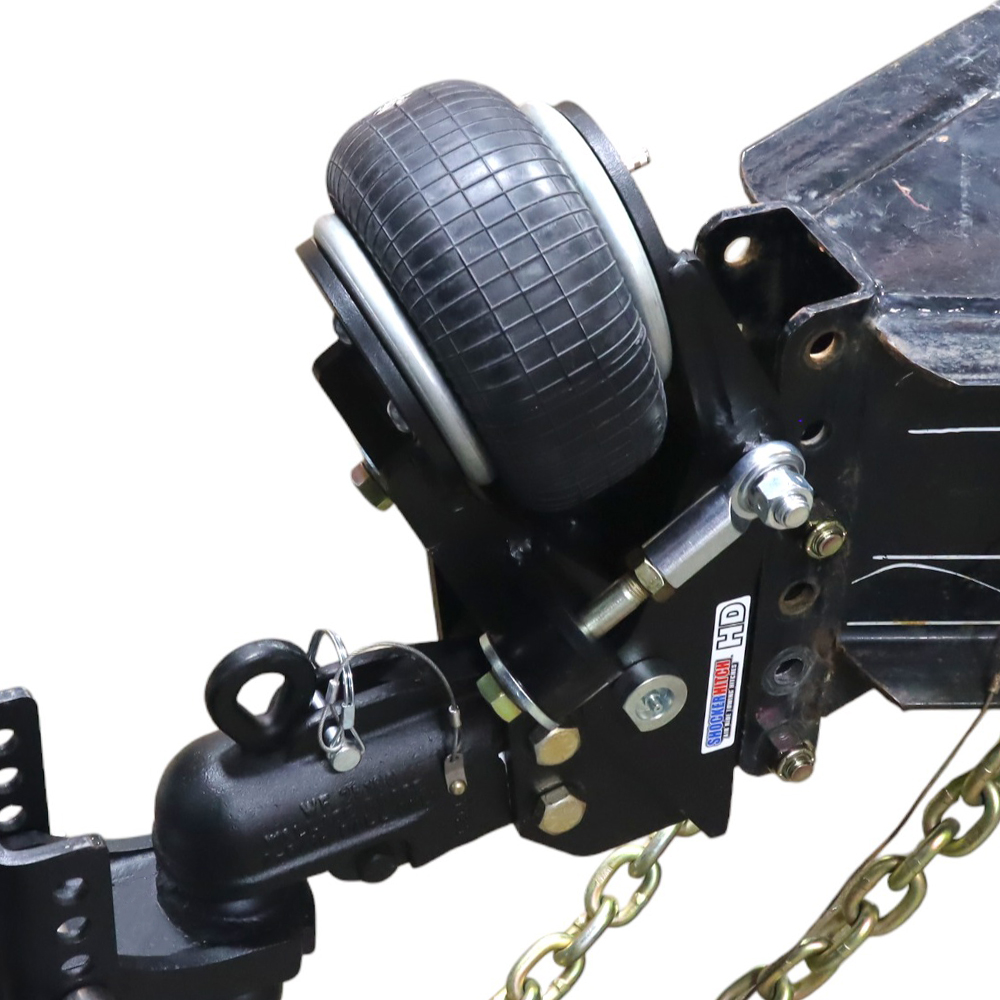

Shocker hitch options for bolt-on trailer tongues
- Air Ride Tongue Mounts for Vertical Channels — for compatible trailer A-frame channel mounts, with the appropriate coupler or pintle ring.
- Air Ride Tongue Mounts for Four-Bolt Flat Plates — for compatible flat-plate mounting patterns; check the kit dimensions and connection.
Ball connection in the truck bed
Gooseneck trailers: match the stem and coupler
A gooseneck trailer commonly connects to a ball in the truck bed. Shocker Gooseneck Surge® Air Hitch and non-air coupler options replace the compatible inner stem and coupler on the trailer.
Check these before ordering
- Stem: round or square, its dimensions and available adjustment.
- Pin holes: orientation and arrangement, not just the trailer brand.
- Ball size: the coupler must match the ball and intended application.
- Clearance and ratings: verify the trailer, truck bed and cab clearances along with component ratings.
Options include Shift Lock and Demco couplers. Available sizes and offsets vary by model; choose from the exact product’s fitment options. An offset coupler is not a substitute for checking turning clearance.
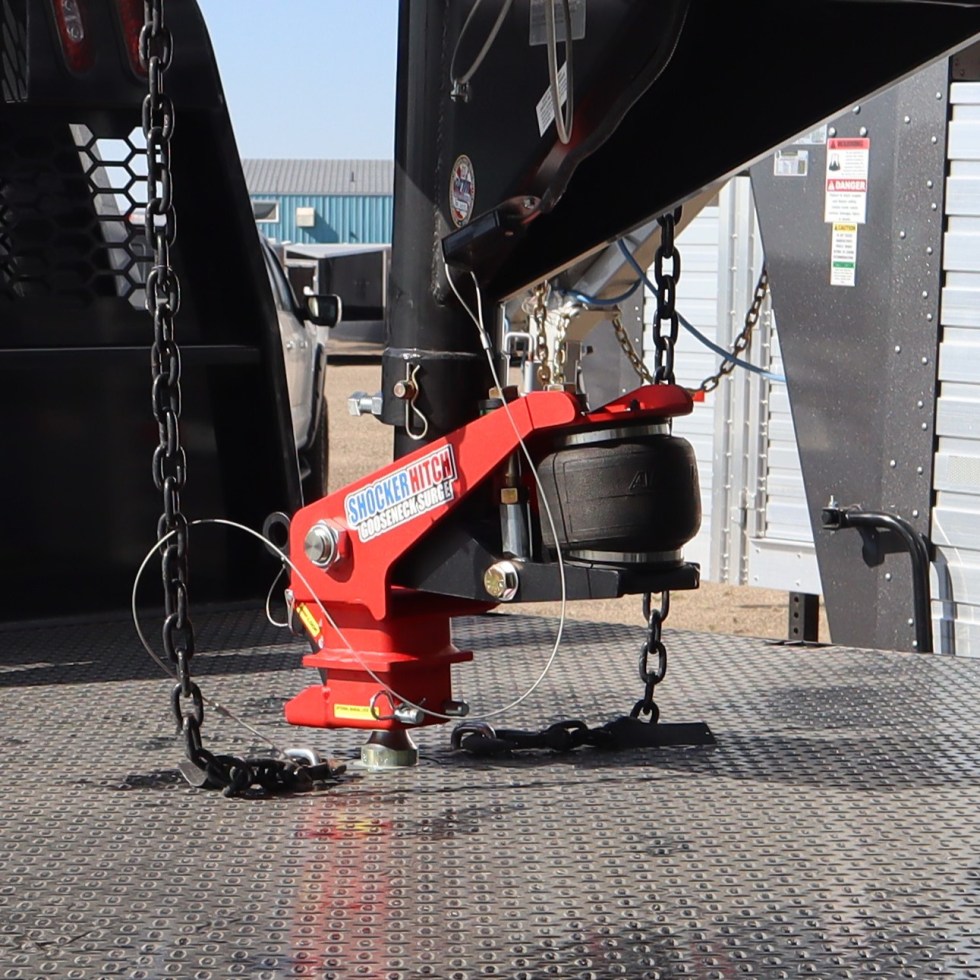
Choose your fit: Gooseneck hitch selection · Stem measurements · Offset coupler guide
Shocker hitch options for gooseneck trailers
- Gooseneck Surge® Air Hitches — air-ride stem and coupler assemblies with Shift Lock or Demco options, depending on the model.
- Non-Air Gooseneck Hitches & Couplers — replacement stem and coupler options when an air-ride assembly is not needed.
- Offset Gooseneck Couplers — offset options, including 9-inch models, where compatible; verify bed, cab and turning clearances.
- Gooseneck Hitches with Kingpin — options for compatible kingpin applications; confirm the truck-side hitch and trailer fit before ordering.
Match the exact coupler to the ball: Demco options include 2-5/16-inch applications, while Shift Lock options include 2-5/16-inch and 3-inch applications. These are model-specific choices, not interchangeable ball sizes.
Kingpin and pin-box connection
Fifth-wheel trailers: identify your pin box
A conventional fifth-wheel trailer uses a kingpin and a fifth-wheel hitch. The pin box is the assembly attached to the front of the trailer; its exact mounting pattern matters when selecting a replacement.
Shocker offers two different Quick Air® paths for compatible applications:
- Air-ride pin box with kingpin: retains a fifth-wheel connection.
- Fifth-wheel-to-gooseneck conversion: changes the trailer-side assembly to a compatible gooseneck connection.
These are different systems. Verify the pin-box model, mounting pattern, trailer requirements, truck-bed hitch and clearances before selecting either. A camper’s year, make and model alone may not identify its pin box.

Unsure which connection you have? Compare fifth-wheel and gooseneck connections.
Shocker hitch options for fifth-wheel trailers
- Quick Air® Fifth-Wheel Pin Box with Kingpin — replaces a compatible pin box while retaining a fifth-wheel kingpin connection.
- Fifth-Wheel-to-Gooseneck Conversion Kits — compatible conversion options, including Quick Air® air-ride systems and non-air coupler configurations. Choose the appropriate Shift Lock or Demco configuration for the specified ball.
Confirm the original pin-box model and mounting pattern, trailer requirements and truck-side hitch compatibility for the exact kit.
Before you choose a hitch
- Identify the connection. A photo of the trailer coupler or pin box helps distinguish the options.
- Measure the fit. Gather receiver, stem or pin-box information using the relevant guide above.
- Check the loaded combination. Confirm vehicle, trailer, axle, tire and hitch ratings; choose equipment for the actual load.
- Follow the installation and pre-trip checks. Use the model-specific instructions for connection, adjustment and inspection.
Common trailer-type questions
Is a tag-along trailer the same as a bumper-pull trailer?
Yes, those names are commonly used for a trailer that connects behind the tow vehicle. Check its actual coupler or ring and use compatible rated towing hardware.
Is a tongue-mount trailer a fourth trailer type?
In this guide, it is a bumper-pull mounting option. The vertical channel or flat plate determines which trailer-side mount may fit.
Can I select a hitch using only my truck or trailer brand?
Brand information helps, but verify the hardware. Receiver hitches need receiver and height measurements; gooseneck replacements need stem and coupler details; fifth-wheel replacements need pin-box compatibility.
Are horse trailers always gooseneck trailers?
No. Horse trailers can use bumper-pull or gooseneck connections. See the horse trailer types guide and horse trailer hitch guide.
Need help finding the right hitch for your trailer?
Have a photo of the connection, the relevant measurements and your loaded trailer details ready. We can help you narrow down compatible options.
More towing help: Air-ride benefits · Trailer sway · Trailer chucking
Load-support reference: Air Lift’s vehicle weight-rating guidance. Always follow the instructions for your exact vehicle, trailer and hitch.