



Backing a gooseneck trailer is easier when you plan the path, move slowly and make small corrections. This guide explains the bottom-hand steering method, how to straighten out, common mistakes and when to stop and reset.
Why a gooseneck backs differently
A gooseneck pivots at the hitch ball in the truck bed, typically over or near the rear axle, rather than behind the bumper. Trailer length, axle position and the truck-to-trailer angle affect its response. Learn how your own combination reacts; do not assume it will behave like another trailer.
Before you reverse
- Walk the intended path. Check for people, pets, posts, curbs, soft ground, slopes and overhead obstacles. Leave room for the truck’s front end to swing and for a pull-forward reset.
- Check clearance between the gooseneck nose and truck cab, bed sides and tailgate. Watch clearance throughout the maneuver, especially on uneven ground. There is no universal safe turning angle for every truck and trailer.
- Adjust both side mirrors so you can monitor the trailer sides and wheel paths. A camera adds another view; it does not show every blind spot or replace mirror and clearance checks.
- Use a spotter when visibility is limited. Agree on clear signals and a stop signal before moving. The spotter must stay visible to the driver and outside the vehicle path, never between the truck and trailer or directly behind the moving trailer. Stop immediately if you lose sight of the spotter.
- Confirm the trailer is properly coupled and secured according to the equipment instructions. If you cannot confirm the path is clear, stop and check before moving.
Step-by-step: back up a gooseneck trailer
1. Line up and choose your path
For straight backing, begin with the truck and trailer as straight as practical. For an angled space, plan where the trailer wheels need to travel and leave room to straighten the truck. Choose visible ground reference points and a stopping point.
2. Use the bottom-hand steering method
Start with the steering wheel centered and one hand at the bottom, at 6 o’clock. To begin moving the rear of the trailer left, move your bottom hand left. To begin moving the rear of the trailer right, move your bottom hand right. Make a small input, then watch the trailer’s response.
This describes the movement of your hand at the bottom of the wheel, not the direction of the wheel’s top. For the initial correction from a straight position, moving your bottom hand left rotates the wheel clockwise; moving it right rotates the wheel counterclockwise. As the truck and trailer angle changes, adjust to their actual movement rather than holding the same steering input.
3. Creep backward and make small corrections
Move at a slow, controlled crawl and stay ready to stop. Allow time to see each steering input work. Avoid repeatedly adding more steering before the trailer responds; large corrections can quickly increase the angle between the truck and trailer.
4. Scan both mirrors, the wheel paths and clearances
Watch where the trailer tires are tracking, but also check the trailer’s rear corners, obstacles, truck front-end swing and cab-to-trailer clearance. Alternate between both mirrors and use the camera as an additional view. If you lose the view you need to judge clearance, stop and check rather than continuing blind.
5. Bring the truck back into line
Once the trailer is following the intended path, gradually countersteer to bring the truck back into alignment behind it. Reduce the steering input as the combination straightens. Do not keep the wheel turned and let the truck-to-trailer angle tighten.
6. Stop and pull forward when needed
If the trailer drifts off the intended path, the angle becomes too tight, clearance is shrinking or visibility is uncertain, stop. Check that the forward path is clear, then pull forward slowly to reduce the angle and reset. Do not force a nearly jackknifed combination farther backward. Several small resets are better than risking contact or damage.
Common backing mistakes and fixes
- Oversteering or correcting too late: slow down, make smaller inputs and watch the result before adding more steering.
- Watching only the trailer’s rear: include the tire paths, both rear corners, truck swing and hitch-area clearances in your scan.
- Forgetting to straighten the truck: begin countersteering as the trailer reaches the desired path instead of waiting until the angle is too tight.
- Backing too fast: use a controlled crawl so you have time to stop and correct.
- Relying only on a camera: use both mirrors and a spotter when needed; stop if an important area cannot be seen.
- Skipping the setup: walk the area, identify obstacles and plan a pull-forward route before reversing.
Practice before a tight parking job
Use a level, open area away from traffic and pedestrians, with permission where needed. Start with straight-line backing, then practice gentle turns and angled parking around soft markers. Repeat the stop-and-reset procedure until you are comfortable with your combination.
Frequently asked questions
Which way do I steer to move the trailer left?
Starting straight with your hand at 6 o’clock, move that bottom hand left to begin directing the trailer’s rear left. Keep the input small and watch the response. Do not confuse bottom-hand movement with turning the top of the steering wheel left.
Can I rely on the backup camera alone?
No. Use it alongside both side mirrors and clearance checks. Stop if you cannot see what you need to judge the path safely. If you use a spotter, stop immediately when the spotter is no longer visible.
How sharp can I turn before the trailer hits the truck?
That depends on the truck, trailer nose, hitch position, any offset and the terrain. Do not assume a gooseneck or an offset coupler guarantees clearance at a particular angle. Follow the equipment instructions and stop before any part can make contact.
Is pulling forward a mistake?
No. Pulling forward to realign is a normal part of backing, including for experienced drivers. Stop first and verify the forward path is clear.
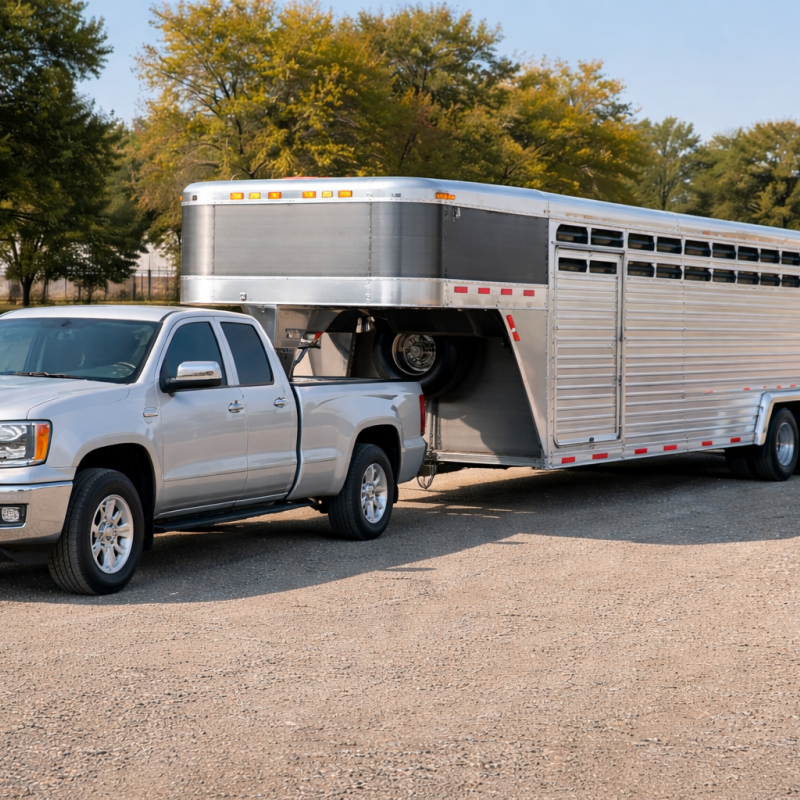
Find an empty parking lot or open area to practice your backing skills. Try straight-line backing, then gentle turns and angled parking. With a little practice, you’ll start to “feel” how your trailer reacts to each steering input.