
Replacing Receiver Shank on Shocker Hitch
Shocker Hitch repair guide
Follow the procedure for your air or cushion receiver hitch. Keep the pivot hardware and bump cushions in the correct order so the hitch can move as designed.
Before you start
Identify your hitch model and match the replacement parts to it. Unhook the trailer and support the hitch securely before disassembly. For an air hitch, release all air pressure before removing the air bag, air line or hardware.
Use the instructions for your hitch type: the air hitch procedure leaves 2–3 bolt threads visible past the jamnut; the cushion hitch procedure leaves 1–2 threads past the rear nut. These are replacement assembly instructions, not a routine air-pressure adjustment.
Choose your system · 1 of 2
Air receiver hitch
Remove the bump cushion assembly
Start by loosening the jamnut from the top bolt using a 1-1/8” wrench on the bolt head and an impact wrench with a 1-1/16“ socket (or equivalent) on the jamnut. Once loosened, pull the bolt, bump cushions, and washer apart from the main hitch frame, set aside for later installation.
Remove the pivot bolt and shank
Loosen the pivot bolt nut using an impact wrench with a 1-7/16” socket (or equivalent). Once loosened, pull out the bolt and remove the washer from the main hitch frame and remove the receiver shank, set hardware aside for later installation. NOTE: You may need to use a rubber mallet to get the pivot bolt to slide out.
Grease the new shank and pivot bolt
Take new receiver shank and add a generous amount of grease to the inside where the pivot bolt sits, do the same process for the pivot bolt.
Install the new shank
Once greased, take new receiver shank and line it up with the pivot bolt hole on the main hitch frame and the air bag paddle. Insert the pivot bolt through these holes with the pivot bolt flat head sitting on the welded tab. Install the washer and finger thread the pivot bolt nut and finish tightening with an impact wrench with a 1-7/16” socket (or equivalent) until the pivot bolt nut is snug against the washer. NOTE: DO NOT overtighten the pivot bolt nut as it may damage the main hitch frame.
Reassemble the bump cushions
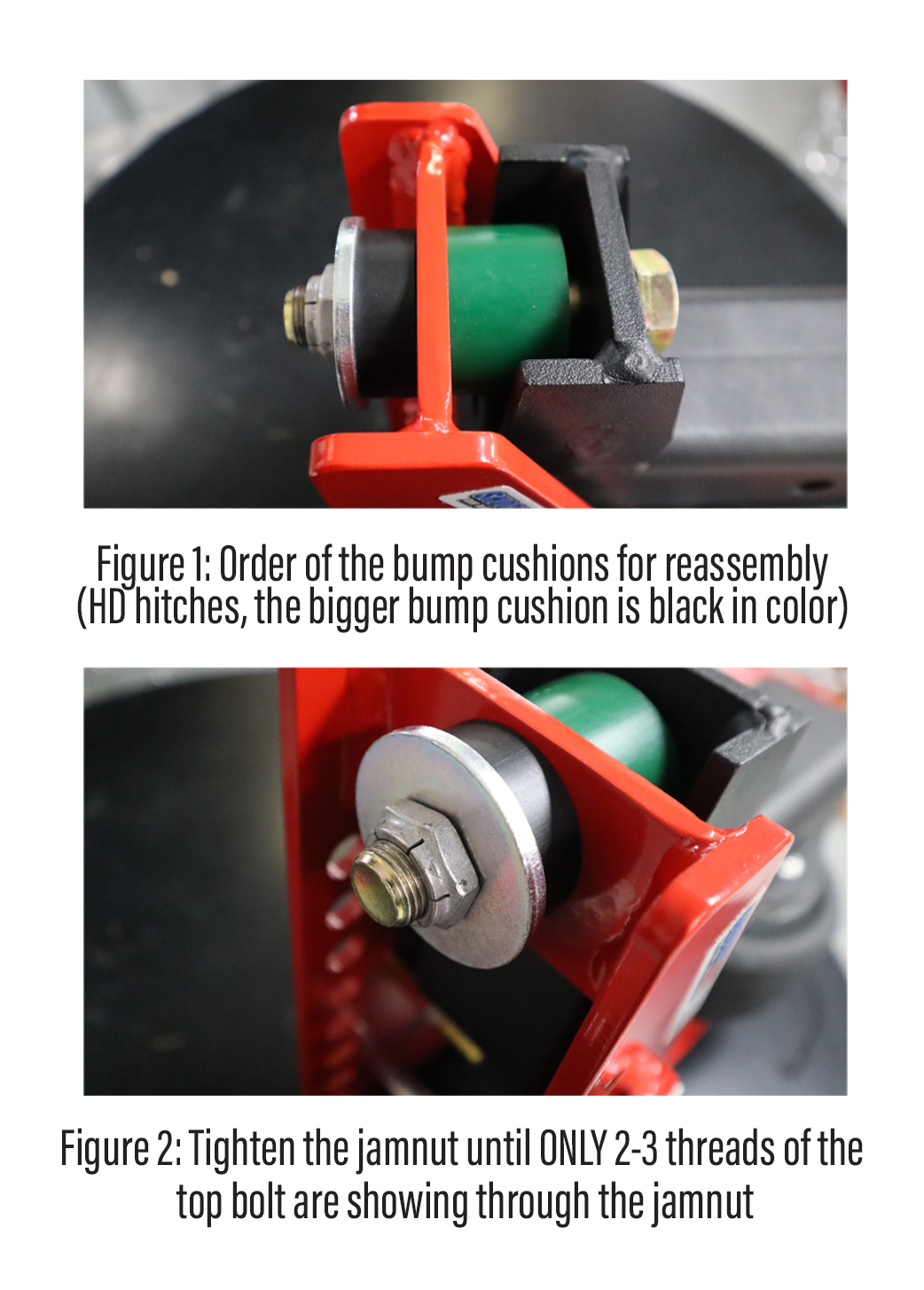
Assemble the bump cushion assembly by inserting the top bolt through the backside of the receiver shank and hitch frame, be sure to insert the bigger bump cushion between the receiver shank and main hitch frame, then slide the bolt through. Continue by sliding the smaller bump cushion over the bolt on the front side of the hitch frame, slide the washer over, add a small amount of thread lock to the jamnut, and finger thread the jamnut (see Figure 1 for reference).
Set the jamnut position
Finish by tightening the jamnut using a 1-1/8” wrench on the bolt head and an impact wrench with a 1-1/16“ socket (or equivalent) and tighten until there are 2-3 threads of the bolt showing the other side (see Figure 2). NOTE: The receiver shank frame should be perpendicular with the hitch frame.
Check movement and spacer requirements
IMPORTANT: DO NOT overtighten the jamnut on the bump cushion assembly past 2-3 threads, this can prevent the hitch from pivoting and prevent the hitch from functioning properly. If you are changing your receiver shank from a 2” to either a 2-1/2” or 3”, you will need to remove the spacer block with a 7/32” Allen wrench.
Choose your system · 2 of 2
Cushion receiver hitch
Remove the bump cushion assembly
Start by loosening the rear nut from the top bolt using a 1-1/8” wrench on the bolt head and an impact wrench with a 1-1/8“ socket (or equivalent) on the nut. Once loosened, pull the bolt, cap, and bump cushions apart from the main hitch frame, set aside for later installation.
Remove the pivot bolt and shank
Loosen the pivot bolt nut using an impact wrench with a 1-7/16” socket (or equivalent). Once loosened, pull out the bolt and remove the washer from the main hitch frame and remove the receiver shank, set hardware aside for later installation. NOTE: You may need to use a rubber mallet to get the pivot bolt to slide out.
Grease the new shank and pivot bolt
Take new receiver shank and add a generous amount of grease to the inside where the pivot bolt sits, do the same process for the pivot bolt.
Install the new shank
Once greased, take new receiver shank and line it up with the pivot bolt hole on the main hitch frame. Insert the pivot bolt through the hole with the pivot bolt flat head sitting on the welded tab. Install the washer and finger thread the pivot bolt nut and finish tightening with an impact wrench with a 1-7/16” socket (or equivalent) until the pivot bolt nut is snug against the washer. NOTE: DO NOT overtighten the pivot bolt nut as it may damage the main hitch frame and prevent the hitch from functioning properly.
Reassemble the bump cushions
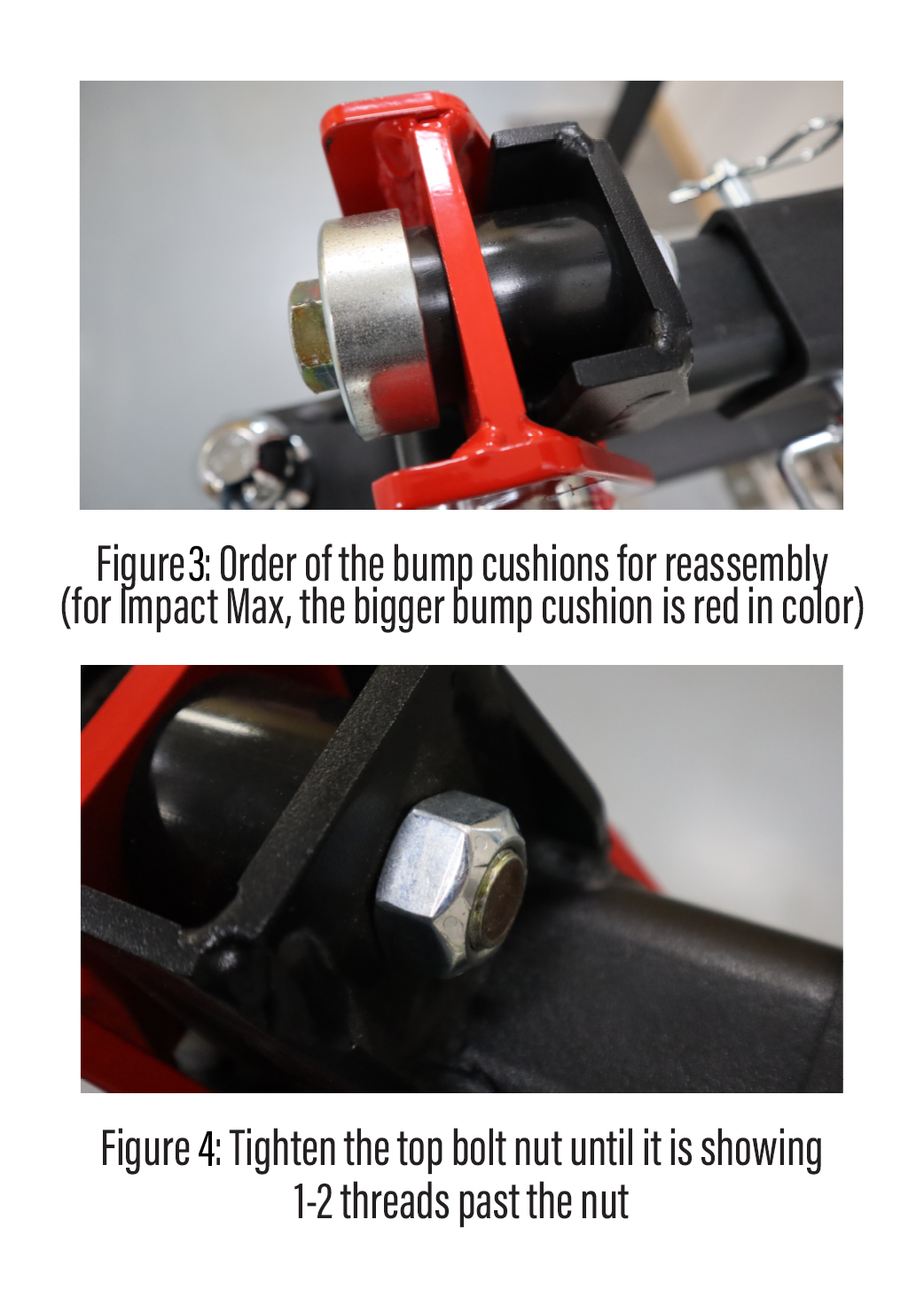
Assemble the bump cushion assembly by inserting the smaller bump cushion into the cap and inserting the top bolt through the smaller bump cushion and cap. Continue by inserting the bigger bump cushion between the receiver shank and main hitch frame, then slide the bolt with the preassembled smaller bump cushion and cap through the front of the hitch frame and bigger bump cushion, add a small amount of thread lock to the rear nut, then finger thread the rear nut onto the bolt (see Figure 3 for reference).
Set the rear nut position
Finish by tightening the jamnut using a 1-1/8” wrench on the bolt head and an impact wrench with a 1-1/8“ (or equivalent) socket and tighten until it is showing 1-2 threads past the nut (see Figure 4). NOTE: The receiver shank frame should be perpendicular with the hitch frame.
Check hitch movement
IMPORTANT: DO NOT overtighten the nut on the bump cushion assembly, this can prevent the hitch from pivoting and prevent it from functioning properly.
After the repair: check your setup
- Reinstall and secure the hitch. Fully insert the receiver shank, align the holes and secure the 5/8-inch hitch pin and cotter clip. Check that the ball-mount pins and clips are seated and locked.
- Lubricate the pivot. Grease the main pivot bolt through its grease fitting. Grease the hitch ball as recommended in the installation guide.
- For air hitches, reset pressure under load. Hook up and load the trailer as you normally would for travel. Add air until the main frame lightly compresses the truck-side bump cushion. Follow the spacer and paddle guidance for your model in the installation guide.
- Never exceed 100 PSI in the air bag. This is the maximum, not a recommended towing pressure. The correct setting depends on the loaded trailer.
- Do not tighten the top jamnut as a routine adjustment. After the replacement assembly is correctly set, extra tightening can restrict the hitch pivot and create a stiff ride.
- Before towing: check the trailer is level, the coupler is secured, and the safety chains and electrical cord are connected. Stay within the lowest-rated component’s capacity.
Watch the air receiver shank replacement
Need help with your receiver shank?
Have your hitch model and a photo of the assembly ready. Our team can help identify the right replacement parts and instructions.